 PetCare Updates

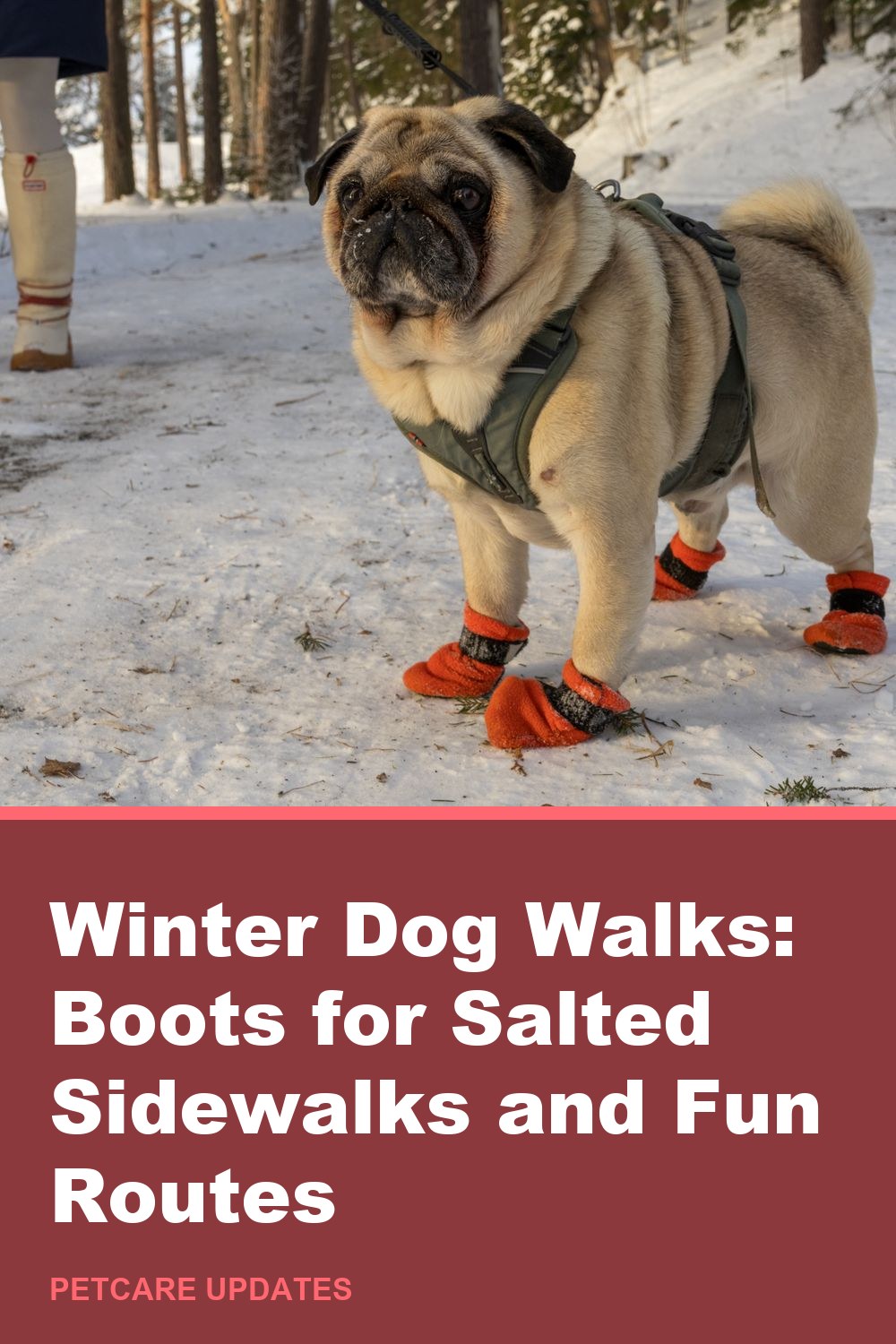

If your winter walks run along sidewalks treated with salt or ice melt, your dog's paws are taking the hit. According to Whole Dog Journal, boots with thick soles can help prevent chemical burns from walking on salted ice. The good news is that a cold-weather walk does not need to be long to be worthwhile. Canine Journal points out that sniffing time, a different route and a few simple games can make a walk more rewarding without adding distance.
Why salted sidewalks are a problem for paws
Whole Dog Journal lists ice and salt as the first situation where boots are helpful. Walking on ice treated with salt or ice melt can cause chemical burns, and a sturdy sole puts a barrier between the paw pad and the ground.
The same publication is clear that not every dog needs boots. They make the most sense in three cases:
- Salted or de-iced surfaces: thick-soled boots protect against chemical burns.
- Freezing temperatures: dogs with little or no hair on their feet may stay warmer, and you may be able to walk or exercise them for longer.
- Snow with long coats: boots can stop snowballs from forming in the hair.
If your dog's paws look sore or irritated after walks, ask your vet rather than guessing.
What to look for in a winter boot
Whole Dog Journal's testing comes down to a few traits. Fit comes first: the boot should stay on and feel comfortable while your dog walks or runs. Very active dogs tend to do better in a sock-style bootie that moves with them. Slower dogs who need more traction usually do well in a shoe style with a rubber sole.
Beyond that, match the boot to your weather and your dog:
- Insulation: choose it if your dog gets cold feet in snow or freezing temperatures.
- Waterproofing: go fully waterproof if you get rain or heavy, wet snow. Water-resistant is usually enough for dry snow, especially on short outings.
- Traction: older dogs, or dogs with injuries or disabilities, are better served by a thick rubber sole than a sock-style boot with no separate sole.
Four tested boots compared
The table below summarises what Whole Dog Journal reported for each pair it highlighted.
| Boot | Style and protection | Best for | Drawbacks noted |
|---|---|---|---|
| Canada Pooch Soft Shield | Fleece-lined, insulated, water resistant, rubber grips on the bottom | Small breeds and dogs with short, single coats or low body fat in extreme cold | Several sizes are often out of stock on Amazon, so buying direct may mean paying for slower shipping |
| Wilderdog Dog Booties | Sock-style, grippy rubber bottom, no insulation | Mildly icy conditions and a physical barrier for paw pads | Only 3 sizes; a bit boxy in shape |
| Non-stop Dogwear Contact Bootie High | Soft, flexible, higher profile with cinching closures; no sole or grip | Quick cold walks, hikes, runs, dry powdery snow; stays on best for very active dogs | Not fully waterproof, no added traction, wears out faster |
| Ruffwear Polar Trex | Vibram rubber sole, waterproof, small amount of insulation, zip-up gaiter | Protection from de-icer and traction on ice and wet, slippery surfaces | Gaiter was too loose to keep snow out in testing; needs careful sizing |
Whole Dog Journal also notes that Ruffwear has introduced a newer version of the Polar Trex with improved traction, fit and gaiter closure.
How to measure your dog's paws
Sizing decides whether a boot stays on. Whole Dog Journal advises measuring the widest part of the paw while your dog stands and puts weight on it. Front paws are often slightly bigger than back paws, so measure all four.
If the sizes differ, look for boots sold in sets of two so you can buy a larger pair for the front and a smaller pair for the back. Ruffwear's Polar Trex is sold this way. If a brand has no size close to your dog's measurement, consider a different brand, since some offer more sizes than others. Wilderdog, with just three sizes, is a good example of a narrow range.
Keeping shorter winter walks interesting
Boots solve the paw problem, but a dog who is walking less still needs something to do. Canine Journal's advice is that you do not need another mile to enrich a walk. Here are the ideas from that guide that suit a short outing best.
- Let your dog sniff. Canine Journal describes sniffing as natural mental enrichment. Even five or ten minutes of uninterrupted sniffing lets a dog enjoy the walk on their own terms. If you are short on time, allow 10 to 15 seconds at an interesting scent, then use a cheerful “let's go” cue.
- Create “sniff zones.” Pick a few stretches of your usual route where your dog gets extra time to explore.
- Let your dog choose the route. At a fork or intersection, let your dog pick the direction. Step in around traffic, unfamiliar dogs or anything risky.
- Walk your loop in reverse. The same distance in the opposite direction changes what your dog sees and smells.
- Try a sniff walk on a long line. Canine Journal suggests starting with 10 to 15 feet, attached to a well-fitting harness, in a quiet open space. Once or twice a week is enough. It also works for recall practice: call your dog back, reward with a treat and praise, then let them go sniff again.
For long-line walks, supervise closely, avoid wrapping the line around your hand, watch for obstacles, other dogs and tangles, never let your dog sprint to the end of the line, and check local leash-length rules.
What this means for you
Use this short checklist before your next cold-weather walk:
- Look at your route. Salted or de-iced sidewalks are the main reason to reach for boots with a thick sole.
- Look at your dog. Little hair on the feet, a short single coat, small size, or long feathering that collects snowballs all point toward boots.
- Pick the style by activity. A sock-style bootie suits a dog who runs. A rubber-soled boot suits a slower dog, or one who is older, injured or has a disability.
- Measure before you buy. Measure all four paws standing, and buy front and back sizes separately if they differ.
- Let your dog get used to them. Check that the boots stay on and your dog moves comfortably before relying on them for a full walk.
- Spend the saved distance on enrichment. Build in a sniff zone, reverse your loop or let your dog choose a turn.
If your dog has existing paw problems, mobility issues or seems uncomfortable in the cold, ask your vet what is right for them.
FAQ
Do dogs really need boots in winter?
Not all of them, according to Whole Dog Journal. They are most useful on salted or de-iced surfaces, for dogs with little hair on their feet in freezing temperatures, and for long-coated dogs who collect snowballs.
Should I buy waterproof or water-resistant boots?
Whole Dog Journal recommends fully waterproof boots if you get a lot of rain or heavy, wet snow. If your snow is usually dry, water-resistant boots are generally fine, especially for short outings.
How can I make a short winter walk more fun for my dog?
Canine Journal suggests giving your dog more time to sniff, letting them choose a turn, walking your usual loop in reverse, or trying a long-line sniff walk in a quiet open space. None of these requires a longer walk.
As an Amazon Associate I earn from qualifying purchases. Links open a search on the Amazon store for your country.
Watch or listen to this episode
Sources
- Whole Dog Journal: Best Winter Boots for Dogs
- Canine Journal: 13 Easy Ways To Make Dog Walks More Fun (Without Walking Farther)
Photo: Surdu Horia / Pexels

I'm an Italian creator who builds apps, games and websites. I run PetCare Updates with the help of AI tools: every article starts from the sources linked above, and I check what goes out. I'm not a doctor, a lawyer or a financial adviser. Spotted a mistake or have an idea? Write to me.
Instagram @spartaco_94_My websiteWrite to meAbout this blog










 The Basics of Puppy Training: A Comprehensive Guide
 Understanding Feline Behavior: Training Your Cat
 Solving Common Behavioral Issues in Dogs and Cats





